Buying guide
Bedroom wall lights: how to choose them
Mounted on the wall either side of the bed, a wall light frees up the bedside table, puts light exactly where you read and gives the bedroom a softer glow than a ceiling light. The trick is getting the height, the material and the light right. Here is what we have learned.
Why a wall light in the bedroom
A bedside lamp takes up half of a small nightstand and is easy to knock over. A wall light lives on the wall instead: the table stays free for a book and a glass of water, and the light comes from higher up, straight onto the page. It is especially useful in a small bedroom, behind a wide headboard that leaves no room for nightstands, or above a low Japandi-style bed.
Most people fit them in pairs, one each side of the bed, so each person can read without disturbing the other. They work alongside an ambient light (a or a dimmed ceiling light) rather than replacing it.
How high to mount a wall light by the bed
The right height depends on your bed, your mattress and how you like to read. These guidelines work in most bedrooms:
- Height: the light source should sit a little above your shoulder when you lean against the headboard, usually 60 to 75 cm above the mattress, which means roughly 120 to 150 cm from the floor depending on the bed.
- Side position: directly above the nightstand, or 15 to 30 cm from the edge of the bed. Too close to the middle and the light bothers whoever is asleep.
- With a headboard: place the light above or just beside it, never level with the top of the headboard, which would cast a shadow.
- A simple test: sit up in bed with a book, ask someone to hold the light against the wall, and pencil a mark where it lights the page without glare.
Measure before drilling and check the projection: a light that sticks out 15 to 25 cm must not catch your head when you sit up.
Which material to choose
The material decides how the light spreads. After height, it is the most important choice.
- Rattan: the woven shade throws patterns of shadow onto the wall and softens the light. A hand-woven rattan wall light makes a bedroom feel warm and natural at once. For something more graphic, the white rattan cone wall light casts a radiating halo. To tell the fibres apart, read our guide to rattan, wicker, raffia and seagrass.
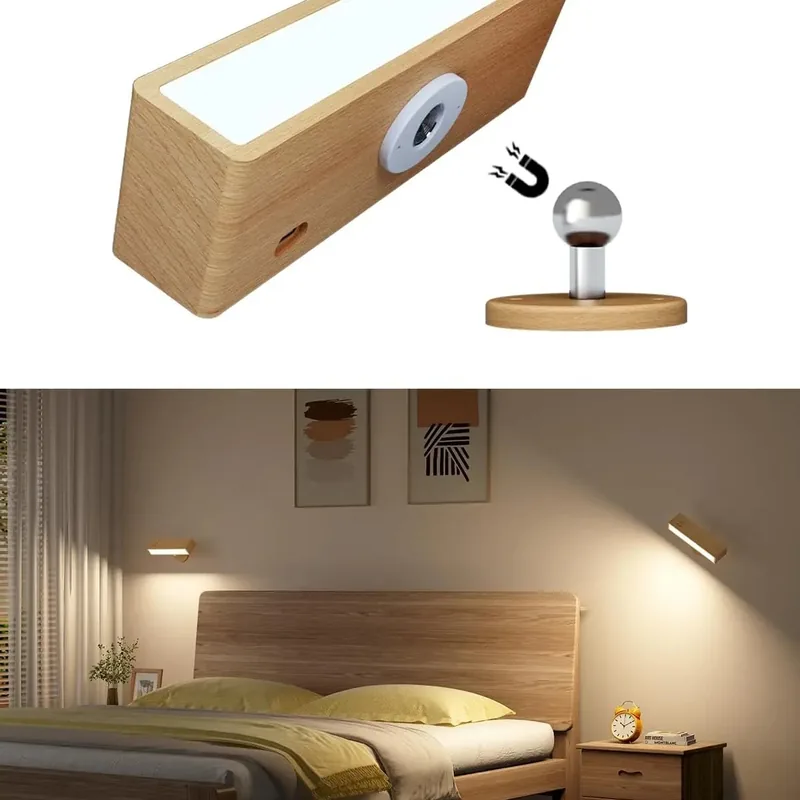
- Wood: warm and understated, it suits an oak or walnut bed. The cordless wooden wall light comes in pale beech or dark walnut.
- Linen: a linen shade filters light like a sheer curtain, with no visible hot spot. The bedside wall light with a linen shade and black metal arm is a classic that fits anywhere.
- Brass: it brings a warm, slightly vintage note and mellows over time. Paired with hammered amber glass, as on the brass and amber glass wall light, it gives a golden, enveloping glow.
- Ceramic: opaque, it sends light up and down without ever dazzling. The fluted ceramic and brass wall light comes in three shapes with an adjustable arm.
- Glass and stone: the ribbed glass of the shell wall light (cognac, smoked grey or milky white) has a retro charm, while the natural stone disc wall light reveals the veining of the stone when lit.
A black wall light gives the wall structure and looks sharp against pale bedding; brass and amber glass warm up white walls; rattan and linen suit softer interiors. See every model in our wall lights.
Warm light: 2700 to 3000 K
In a bedroom, colour temperature matters more than brightness. Choose a warm white bulb between 2700 and 3000 K: close to the old incandescent glow, flattering to natural materials and easier on the eyes before sleep. Above 4000 K the light turns neutral, then cool, which is better suited to a desk.
- For reading: an LED of around 400 to 500 lumens is enough for a bedside wall light; any brighter and it glares at close range.
- Colour rendering: a CRI of 90 or more keeps linen and wood from looking dull.
- Dimming: handy for switching from reading light to a soft night light.
- Visible bulbs: under an open shade or clear glass, choose an opal or low-output filament bulb.
Several of our E27 wall lights come with a warm white LED bulb, depending on the model; for the others, the product page tells you which bulb to buy.
Hardwired or cordless and rechargeable
A hardwired wall light is connected to the mains, usually to a cable outlet in the wall. It is the neatest option (no visible cable) and the most durable, but it needs a power point in the right place. Have an electrician do the connection, especially if a new outlet is needed beside the bed.
A cordless rechargeable wall light goes up without any building work. It is the right choice if you rent, if there is no power supply next to the bed, or if you want to try out a position first. Our cordless wooden wall light charges via USB, clicks magnetically onto a wall plate and swivels 360° to aim the light at your book. The trade-off for that freedom is recharging it regularly, depending on use.
Wall lights with a switch: turning them off from bed
Nothing is more annoying than getting up to turn off the light. Depending on the type of wall light, you have several options:
- A switch on the light itself: some models have a button, a pull cord or a touch control on the fitting. The cordless wooden wall light, for instance, switches on and dims at a touch.
- A wall switch by the bed: for a hardwired light, an electrician can fit a switch within reach on each side, possibly two-way with the switch by the door.
- A smart bulb: a connected E27 bulb lets you switch and dim from a remote or your phone, with no wiring changes.
Before ordering, check on the product page how the light is switched on and what you may need to add.
Japandi, wabi-sabi or vintage style
In a Japandi or wabi-sabi bedroom, look for simple shapes and materials that filter light: rattan, linen, matte ceramic, oiled wood. Mount the light slightly lower than usual to match a low bed, and keep the wall around it clear. A pair of fluted ceramic or rattan wall lights and some washed linen bedding in clay tones, and the room is done.
For a more vintage feel, go for brass, amber glass or ribbed glass, which recall 1970s lighting. Keep everything else restrained: one strong material per wall is enough.
Frequently asked questions
Wall light or bedside lamp?
A wall light frees the nightstand and lights reading better; a lamp can be moved and needs no drilling. In a small bedroom, the wall light usually wins. See also our bedside lamps.
Do I need two identical wall lights?
For a double bed, a matching pair looks balanced. For a single bed against a wall, one is enough.
Can I install a wall light without an electrician?
Yes, with a cordless rechargeable model whose wall plate simply screws on. For a mains-connected light, call a professional.