Buying guide
Washed linen duvet cover: sizes and buying guide
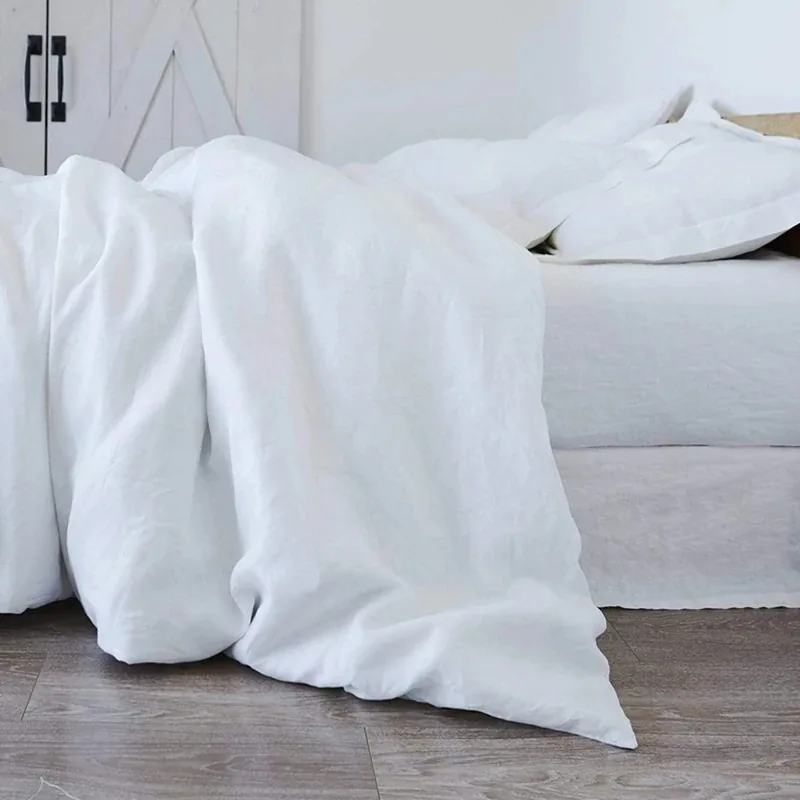
Soft from the very first night, cool in summer and cosy in winter, a washed linen duvet cover changes the look of a bed more than any other piece. The key is choosing the right size, weave and closure. Here is how.
Why choose a washed linen duvet cover
Linen is a long, hollow fibre that lets air circulate and absorbs moisture without feeling damp. The result: you sleep cooler in summer and keep a dry, even warmth in winter. Washed linen adds a supple feel straight out of the packaging, a natural crinkle that means no ironing, and excellent durability. It is one of the few duvet covers that gets better looking with the years.
Washed linen vs regular linen
It is the same fibre. The difference comes at the end of production: washed linen goes through a long wash, often with stones or enzymes, which breaks down the stiffness of the fabric.
- Feel: regular linen starts firmer and slightly crisp, and softens over many washes. Washed linen is soft straight away.
- Look: regular linen stays smoother and can be ironed flat; washed linen has a light, relaxed crinkle.
- Shrinkage: washed linen has already done most of its shrinking, so its dimensions are more stable after your first washes.
- Care: both wash at 40 °C; washed linen needs no iron.
If you love a crisp, ironed bed, regular linen will suit you. If you want a bed that looks good with no effort, choose washed linen.
What size linen duvet cover do you need?
Choose the cover by the size of your duvet, not your mattress. In practice a duvet overhangs the mattress by 30 to 40 cm on each side so it covers sleepers well. Measure your duvet flat before ordering: a few centimetres’ difference is enough to cause folds or leave the duvet loose inside.
UK sizes
- Single: about 135 × 200 cm.
- Double: about 200 × 200 cm.
- King: about 225 × 220 cm.
- Super king: about 260 × 220 cm.
European and US sizes
In France, common sizes are 140 × 200 cm for a single bed, then 200 × 200, 220 × 240 and 240 × 260 cm for doubles. In Germany, people often sleep under individual duvets, even in a double bed: 135 × 200 and 155 × 220 cm are the most common, with 200 × 200 and 200 × 220 cm for shared duvets. US sizes are named Twin, Full/Queen and King, and vary from brand to brand. Exact dimensions differ by a few centimetres between makers, so always compare in centimetres.
Our linen duvet covers come, depending on the model, in sizes from 150 × 200 to 220 × 240 cm; each product page lists the exact sizes, as on the washed linen duvet cover in ten shades.
Fabric weight: does it matter?
Fabric weight, given in g/m² (gsm), tells you how heavy the cloth is. For linen bedding it is usually somewhere around 140 to 190 g/m². A lighter cloth is more fluid and cooler; a heavier one is denser, more opaque and slightly warmer. Beyond the number, an even weave and a careful finish matter just as much: well-washed, well-sewn linen lasts a long time whatever its weight.
One washed linen duvet cover for every season
- Summer: pair the linen cover with a light duvet, or use it on its own as a thick sheet on hot nights.
- Winter: the same cover on a warm duvet. Linen avoids the clammy “sleeping bag” effect of synthetics and keeps the bed dry.
- In between: add a throw at the foot of the bed rather than changing duvets.
Closures and finishes
Buttons, press studs or a discreet closure are a matter of taste and practicality. Buttons, such as the coconut buttons on our washed linen duvet cover with buttons, add an elegant detail; a discreet closure goes unnoticed. Either way, close it before every wash.
Colours: how to combine them
Natural, white and pale greys create a calm, bright bed. Sage green, caramel or charcoal bring more character. A simple rule: one main colour for the duvet cover, a neighbouring shade for the fitted sheet and pillowcases, and a single accent (a throw or cushion). The crinkle of washed linen softens even deep colours. For a complete matching bed in one go, see the 4-piece pure linen bedding set, and add a deep fitted sheet if your mattress is thick.
How to put on a duvet cover easily
Turn the cover inside out and slide your hands inside to the two far corners. Use them to grab the two corners of the duvet, then shake so the cover unrolls over the duvet like a sock. Close it, give one last shake while holding the corners, and the duvet settles evenly. With soft washed linen it takes less than a minute.
Care in brief
Wash at 40 °C on a gentle cycle with mild detergent, no fabric softener, then line dry or tumble on low. Every detail is in our guide how to wash linen sheets, and our linen bedding guide helps you choose sheets and pillowcases.
Frequently asked questions
Should the cover be bigger than the duvet?
No: choose exactly the size of the duvet. A cover that is too big lets the duvet slide around and bunch up inside.
Is washed linen scratchy?
No. Washing at the end of production softens the fibre; it feels soft from the first night and becomes even more supple with each wash.
How many duvet covers do you need?
Two per bed is a good balance: one on the bed, the other in the wash or resting. Linen lasts longer when it is rotated.